
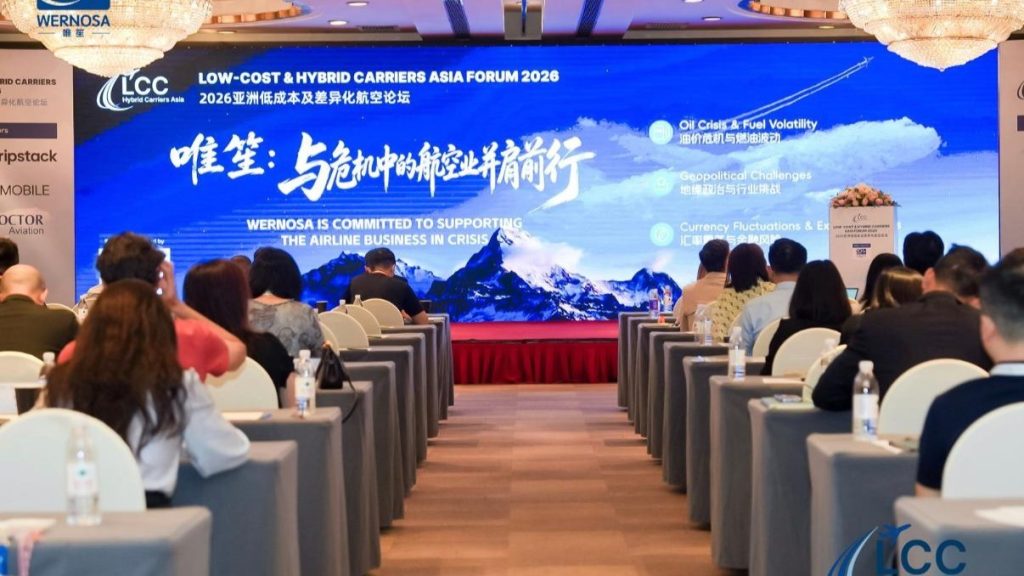
Shanghai, May 28-29
Low-cost carriers spent two decades perfecting the art of doing less: fewer fare types, fewer frills, lower costs. At the Low-Cost & Hybrid Carriers Asia Forum 2026 in Shanghai on May 28-29, the talk was mostly about doing more. The industry calls it hybridisation, and the debate around it was sharper than these events usually manage. AirFi’s Director Asia, Jane Phan, was on the ground in Shanghai for the summit. Here are the five takeaways worth carrying out of the room.
1. Hybridisation is now a necessity, but LCCs remain wary
The strategy panel was candid about the stakes. Most carriers now treat #hybridisation as a necessity, and one consultant warned that the strategy carries significant risk. The question that kept surfacing was one the room genuinely wrestled with: at what point does a #lowcostcarrier stop being a low-cost carrier? The panel was split. One view, voiced from the manufacturing side, held that low-cost carriers are simply learning from full-service ones and that the drift toward hybridisation is the natural next stage of the model. The more cautious voices warned that the same move, made without strategic control, is how a carrier dilutes the cost advantage that made it work in the first place.
2. The ticket is the entry point, not the product
Scratch the hybridisation debate, and you find economics underneath. Pure base-fare models are more fragile than the industry wants to admit, and the pandemic confirmed it. Carriers have been diversifying revenue ever since, to the point where some low-cost carriers now draw around 45% of their revenue from sources beyond the base fare. One carrier cited at the summit increased its ancillary share from 18% to 30% within a year. It did so by understanding its passengers better and getting sharper about which products and bundles resonate, rather than by adding seats or new cabin classes. The ticket is increasingly the entry point rather than the product.
Pure base-fare models are more fragile than the industry wants to admit, and the pandemic confirmed it.
3. Light beats heavy when you hybridise
The most useful insight from the summit was that the risk of hybridisation is not evenly distributed. It depends almost entirely on how a carrier does it. Selective hybridisation, done with discipline, came up repeatedly as proof that adding capability need not destroy the model. The carriers that get into trouble add complexity piece by piece, each step reasonable on its own, until the costs mount up and the original advantage is gone. The line that matters is not whether you add capability, but what kind it is and what it costs you to carry it for the life of the aircraft.
The carriers that get into trouble add complexity piece by piece, each step reasonable on its own, until the costs mount up and the original advantage is gone.
4. The market is maturing at very different speeds across Asia
Low-cost penetration has reached roughly 56% in Southeast Asia, against around 18% in China and 17% in Japan. That spread means these markets are effectively running the same experiment at different speeds, and you can watch the full evolution, from early growth to mature and crowded competition, play out across neighbouring markets at once. It also explains why the hybridisation question feels urgent in some markets and still theoretical in others.
5. Knowing the passenger is the next big revenue lever
The most forward-looking thread ran through the discussion on connectivity and loyalty. Low-cost carriers have built remarkable reach, carrying enormous numbers of people efficiently, and the next opportunity is to build on that scale by getting closer to who those passengers are. Most still treat the cabin as a closed sixty-minute window when it is really one stop in a journey that starts at booking and continues after landing. The carriers that use what they already know about a passenger to get the offer, the timing and the product right stand to unlock a step change in value, well beyond another upsell.
What it means for the cabin
Hybridisation is happening; ancillary revenue is the reason. The risk lies in doing it too heavily, and the prize is a deeper relationship with the passenger. The carriers that come out ahead will be those that find a way to add intelligence to the cabin without adding weight to the operation.
Hybridisation is happening; ancillary revenue is the reason.
That is the part we find most encouraging, because it is precisely the gap a portable, software-led approach to the cabin is built to fill. The capability that drives ancillary growth is not physical. It is the intelligence layer: knowing what to load, what to promote, what to recommend, and to whom, then closing the loop with the behavioural data the cabin already generates. Delivered on a platform that deploys in days rather than years, moves between aircraft, and updates continuously.
Why AirFi is poised to help airlines navigate change across Asia
At AirFi We believe that capability is what lets a carrier grow beyond the base fare and start to know its passengers without taking on the capex, the weight or the decade-long bet that makes all-in hybridisation a trap. The low-cost carrier model succeeded by knowing exactly what it was. Its next decade depends on becoming something more without forgetting what it was for.